
On April 16th 2025, five justices of the UK Supreme Court delivered a divisive ruling in "For Women Scotland vs The Scottish Ministers".
The case revolved around a technical interpretation of the 2010 Equality Act. The Court unanimously concluded that the terms “woman” and “sex” referred specifically to biological sex; defined as the sex assigned at birth, drawing on precedents from the 1975 Sex Discrimination Act and subsequent legislation.
The Origins of the Case
The legal battle began in 2018, when the Scottish Government sought to improve gender representation on healthcare governance boards. It interpreted the 2010 Equality Act to include transgender women under the category of “woman.” This move was welcomed by many as a step toward inclusivity. However, For Women Scotland, a group of Trans Exclusionary Radical Feminists (TERFs) challenged this inclusion asserting that gender is immutable and strictly defined by birth sex and consequently that transgender women (individuals assigned male at birth who identify and live as women) are not women in any legal or social sense.
Rather than embracing the intended aim of representation and parity, For Women Scotland chose to challenge the Scottish Government’s decision in court, arguing that it infringed upon the rights of cisgender women (ie women certificated female at birth).
The case saw multiple reversals before reaching the Supreme Court in 2024 and ruling made in 2025. Whilst the Court ruled strictly on a technical point of statutory interpretation in relation to gender parity in governance boards, the political and media response cast it as a broader judgment on transgender rights.
The Supreme Court’s Clarification
Importantly, the justices emphasized that the ruling concerned only a narrow legal definition and should not be interpreted as a rollback of transgender rights. The Court explicitly stated:
“… a vulnerable and often harassed community minority, the trans community, struggle against discrimination and prejudice as they seek to live their lives with dignity.”
Yet, for many transgender people and allies, the ruling was perceived as a symbolic victory for TERFs and a setback for trans inclusion. Despite the Court’s counsel that:
“… we counsel against reading this judgement as a triumph of one or more groups in our society at the expense of another.”
The celebratory and vengeful response from For Women Scotland on the steps of the Court suggested otherwise. Compounding the issue, the Equality and Human Rights Commission (EHRC) released new guidance, which had to be restated as “interim guidance” soon after, and which now they claim is nothing other than ‘informal post updates’, further muddling public understanding of the ruling’s intent.
Misinterpretations and Consequences
The EHRC guidance was quickly seized upon by gender-critical groups as justification to exclude transgender women from women’s spaces such as toilets, changing rooms, and support services supposedly for the “safety of women and girls”. Yet this interpretation far exceeded the ruling’s scope.
Sports bodies also cited the ruling as grounds to exclude transgender women from women’s competitions, treating it as definitive resolution to a longstanding debate.
A Catch-22 for all Service Providers
The EHRC guidance created an untenable position for public and private service providers. Under the Gender Recognition Act 2004, trans people cannot be excluded from single-sex services without lawful justification, which has to be proven to be proportionate. Moreover, Section 8 of the 2018 Data Protection Act protects individuals’ rights to privacy, including gender identity, as does the 1951 European Convention on Human Rights.
If transgender women are forced to use men’s facilities, they face increased risks of harassment, violence, and exposure. At the same time, trans men being forced into women’s spaces violates their dignity and can create discomfort and fear amongst cisgender women.
While the EHRC later clarified that trans men who are “too male presenting” should not be required to use women’s spaces (making a nonsense of their own position), it failed to apply the same logic to trans women, thus showing evident gender bias in its interpretation. The result: widespread confusion and risk of litigation against institutions trying to, and so failing to, comply with contradictory guidance and meanwhile some trans people being excluded from either male or female facilities.
Even the EHRC’s own guidance stated:
“It is not compulsory for services that are open to the public to be provided on a single-sex basis… However, it could be indirect sex discrimination against women if the only provision is mixed sex.”
Again a complete logical nonsense. With no evidence whatsoever that trans women pose a specific threat to cisgender women, any justification for excluding them lacks any legal standing. Freedom of Information requests, such as those submitted to Devon and Cornwall Police, have repeatedly revealed no reported cases supporting the claim of threat.
The Impact on Trans and Cis Communities
The policy creates a paradox that compromises privacy, safety, and equality. Many cisgender women began to see that exclusionary policies would make spaces less safe for everyone. Indeed, police forces quickly declared that male officers had the power and right to strip search trans women.
Transgender men, very often overlooked in public debates, now find themselves in the spotlight as their being seen as men in women’s facilities would be jarring whilst normalizing the presence of men, either trans or more dangerously cisgender in women’s facilities.
Meanwhile, trans women, whether simply socially transitioned or fully medically transitioned, entering men’s spaces would inevitably be vulnerable to either common or sexual assault, independent of the sheer revulsion of having to walk past open urinals.
Support services for victims of rape or domestic violence were also implicated. Calls to exclude trans women ignored the fact that they, too, are disproportionately victims of such crimes. Trans men, likewise, may need these services, but their presence in female spaces can cause distress or discomfort. In reality such facilities already maintain rigorous safeguards: individuals do not simply walk in off the street. That provision for special spaces was already allowed in the Equality Act makes the Supreme Court ruling all the more egregious and redundant.
A Cultural Flashpoint
Cisgender women began to express alarm at the new risks posed by the EHRC guidance. On May 26th, the “Not In Our Name” petition launched, highlighting the potential harm to cis women as well as trans people.
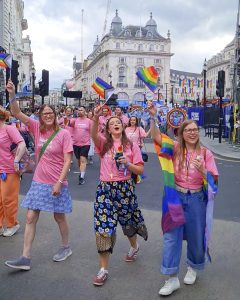
June is recognised as Pride Month in the UK. This year saw an unprecedented surge of trans visibility, the distinctive blue, pink, and white colours of the transgender motif becoming highly visible at Pride events around the country.
Many in the LGBTQIA community viewed the EHRC guidance as a veiled step toward a broader erosion of rights, reminiscent of Section 28 of the 1988 Local Government Act, which prohibited the “promotion of homosexuality.” That clause was repealed in 2000 following significant protest, and comparisons to it now serve as a rallying cry: “Trans rights are human rights.”
On June 25th, approximately 1,000 trans and cis people lobbied Parliament, matching the turnout seen during protests against Section 28. Their goal: to highlight the legal, ethical, and financial consequences of exclusionary policies for corporate and public institutions, transgender individuals and the wider public.
Looking Ahead
The streets now more than ever belong to Pride, not only the LGBTQIA+ community, but their growing ranks of cisgender allies. While less than 1% of the UK population identifies as trans, statistics suggest 1 in 28 people personally know someone who is trans.
In addition, around 1.7% of people are estimated to be intersex and 0.5% identify as nonbinary. These people too are caught up in a strictly binary system based on sex assigned and certificated at birth by a cursory glance at a newborn’s genitals by a clinician. As a result, increasing numbers of people are recognising the real-world harm being done to individuals who simply wish, as the Supreme Court put it, “to live their lives with dignity.”
In this context, many see the push to restrict trans rights not as an isolated issue but as a test case for the wider erosion of human rights. Indeed we already see this in new guidance for school teachers and the overt exclusion of trans women in politics. For now, the Supreme Court’s decision may not have rewritten the law, but it has undoubtedly reshaped the public conversation.
Whether this moment proves to be a turning point remains to be seen. What is clear is that the battle over trans rights in the UK is far from settled and more people than ever are paying attention.
Further reading:
For Women Scotland vs The Scottish Ministers:
https://www.supremecourt.uk/cases/uksc-2024-0042
An interim update on the practical implications of the UK Supreme Court judgment:
https://www.equalityhumanrights.com/media-centre/interim-update-practical-implications-uk-supreme-court-judgment
The 2018 Data Protection Act:
https://www.legislation.gov.uk/ukpga/2018/12/contents
The 2010 UK Equality Act:
https://www.gov.uk/guidance/equality-act-2010-guidance
The 2004 UK Gender Recognition Act:
https://www.legislation.gov.uk/ukpga/2004/7/contents
The Sex Discrimination (Gender Reassignment) Regulations 1999:
https://www.legislation.gov.uk/uksi/1999/1102/contents/made
The 1975 Sex Discrimination Act:
https://www.legislation.gov.uk/ukpga/1975/65/enacted
Sexual orientation and gender identity quality information for Census 2021:
https://www.ons.gov.uk/peoplepopulationandcommunity/culturalidentity/sexuality/methodologies/sexualorientationandgenderidentityqualityinformationforcensus2021
Not In Our Name petition:
https://www.change.org/p/not-in-our-name-women-in-support-of-the-trans-community
Local Government Act 1988:
https://www.legislation.gov.uk/ukpga/1988/9/section/28
(the internet links were functional at the time of writing)